 I loved seeing this children's book out from Richard Bauckham, professor of New Testament at the University of St. Andrews in Scotland.
04 December 2006
Bauckham for Kids
I loved seeing this children's book out from Richard Bauckham, professor of New Testament at the University of St. Andrews in Scotland.

Motivation (18): Ryle
 J. C. Ryle (1816-1900), Anglican Bishop of Liverpool, England:
"True Christians are what they are, because they are regenerate, and formal Christians are what they are, because they are not. The heart of a Christian in deed has been changed. The heart of the Christian in name only has not been changed. The change of heart makes the whole difference."
"Scripture describes regeneration as a great radical change of heart and nature – a thorough alteration and transformation of the whole inner man, a participation in the resurrection life of Christ, or, to borrow the words of the Church Catechism, 'a death unto sin and a new birth unto righteousness.'
"This change of heart in a true Christian is so complete that no word could be chosen more fitting to express it than that word ‘regeneration’ or new birth. Doubtless it is no outward, bodily alteration, but undoubtedly it is an entire alteration of the inner man. It adds no new faculties to a man’s mind, but it certainly gives an entirely new bent and bias to all his old ones. His will is so new, his taste so new, his opinions so new, his views of sin, the world, the Bible, and Christ so new, that he is to all intents and purposes a new man. The change seems to bring a new being into existence. It may well be called being born again."
J. C. Ryle, Regeneration (Fearn, Scotland: Christian Focus, 2003), 12, 14
29 November 2006
Motivation (17): Hodge
 Charles Hodge (1797-1878), American Presbyterian theologian of Princeton Seminary:
"A beautiful object in nature or art may be duly apprehended as an object of vision by an uncultivated man, who has no perception of its aesthetic excellence, and no corresponding feeling of delight in its contemplation. So it is with the unrenewed man. He may have an intellectual knowledge of the facts and doctrines of the Bible, but no spiritual discernment of their excellence, and no delight in them. . . .
"Out of the heart proceed all conscious, voluntary, moral exercises. A change of heart, therefore, is a change which precedes these exercises and determines their character. A new heart is to a man what goodness is to the tree in the parable of our Lord.
"In regeneration, therefore, there is a new life communicated to the soul; the man is the subject of a new birth; he receives a new nature or new heart, and becomes a new creature. As the change is neither in the substance nor in the mere exercises of the soul, it is in those immanent dispositions, principles, tastes, or habits which underlie all conscious exercises, and determine the character of the man and of all his acts."
--Systematic Theology (Grand Rapids: Eerdmans, 1946), 3:33, 35.
27 November 2006
Sin
Is this the way to think of sin in believers?
The Presence of Sin: Completely Present
The Penalty of Sin: Completely Gone
The Power of Sin: Progressively Weakened
A Christian, then, is someone who has had the condemnation of sin removed, while experiencing increasing freedom from sin's hold, while not knowing total freedom until the next life. That is, the penalty of sin has been killed in the past, the power of sin is being killed in the present, and the presence of sin will be killed in the future.
Another important variable, when we enfold unbelievers into the discussion, is the image of God, which is manifestly present in all, believer and unbeliever. This helps us avoid extremes. Remembering the presence of sin in believers keeps us from over-optimism regarding the Christian life, while remembering the imago dei in unbelievers keeps us from over-pessimism regarding the non-Christian life. Unbelievers are not as bad as they might be; believers are not as good as they will be.
Still pondering.
The Presence of Sin: Completely Present
The Penalty of Sin: Completely Gone
The Power of Sin: Progressively Weakened
A Christian, then, is someone who has had the condemnation of sin removed, while experiencing increasing freedom from sin's hold, while not knowing total freedom until the next life. That is, the penalty of sin has been killed in the past, the power of sin is being killed in the present, and the presence of sin will be killed in the future.
Another important variable, when we enfold unbelievers into the discussion, is the image of God, which is manifestly present in all, believer and unbeliever. This helps us avoid extremes. Remembering the presence of sin in believers keeps us from over-optimism regarding the Christian life, while remembering the imago dei in unbelievers keeps us from over-pessimism regarding the non-Christian life. Unbelievers are not as bad as they might be; believers are not as good as they will be.
Still pondering.
Motivation (16): Chalmers
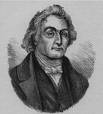 Thomas Chalmers (1780-1847), Free Church Scottish pastor known for his sermon "The Expulsive Power of a New Affection":
"There are a thousand things which, in popular and understood language, man can do. It is quite the general sentiment, that he can abstain from stealing, and lying, and calumny—that he can give of his substance to the poor, and attend church, and pray, and read his Bible, and keep up the worship of God in his family. But, as an instance of distinction between what he can do, and what he cannot do, let us make the undoubted assertion, that he can eat wormwood, and just put the question, if he can also relish wormwood. That is a different affair. I may command the performance; but have no such command over my organs of sense, as to command a liking, or a taste for the performance. . . . I may accomplish the doing of what God bids; but have no pleasure in God himself. The forcible constraining of the hand, may make out many a visible act of obedience, but the relish of the heart may refuse to go along with it. . . . The poor man has no more conquered his rebellious affections, than he has conquered his distaste for wormwood. He may fear God; he may listen to God; and, in outward deed, may obey God. But he does not, and he will not, love God; and while he drags a heavy load of tasks, and duties, and observances after him, he lives in the hourly violation of the first and greatest of the commandments."
--“An Estimate of the Morality that is Without Godliness,” in Thomas Chalmers, Sermons and Discourses, Vol. II (New York: Robert Carter, 1846), 34.
"[T]he love of gratitude differs from the love of moral esteem. . . . There is a real distinction of cause between these two affections, and there is also between them a real distinction of object. The love of moral esteem finds its complacent gratification, in the act of dwelling contemplatively on that Being, by whom it is excited; just as a tasteful enthusiast inhales delight from the act of gazing on the charms of some external scenery. The pleasure he receives, emanates directly upon his mind, from the forms of beauty and loveliness, which are around him. And if, instead of a taste for the beauties of nature, there exists within him, a taste for the beauties of holiness, then will he love the Being, who presents to the eye of his contemplation the fullest assemblage of them, and his taste will find its complacent gratification in dwelling upon him, whether as an object of thought, or as an object of perception. 'One thing have I desired,' says the Psalmist, 'that I may dwell in the house of the Lord all the days of my life, to behold the beauty of the Lord, and to inquire in his temple.' Now, the love of gratitude is distinct from this in its object. It is excited by the love of kindness; and the feeling which is thus excited, is just a feeling of kindness back again."
--“The Principle of Love to God,” in Chalmers, Sermons and Discourses, 64-65.
21 November 2006



20 November 2006
Motivation (15): Whitefield
 George Whitefield (1714-1770), British Calvinist evangelist and, according to Arnold Dallimore, the primary fuel for the spread of 18th-century Methodism (even more than John Wesley), says this:
"It is true, we may flatter ourselves, that supposing we continue in our natural corrupt state, and carry all our lusts along with us, we should, notwithstanding, relish heaven, was God to admit us therein. And so we might, was it a Mahometan paradise, wherein we were to take our full swing in sensual delights. But since its joys are only spiritual, and no unclean thing can possibly enter those blessed mansions, there is an absolute necessity of our being changed, and undergoing a total renovation of our depraved natures, before we can have any taste or relish of those heavenly pleasures. It is, doubtless, for this reason, that the apostle declares it to be the irrevocable decree of the Almighty, that ‘without holiness, (without being made pure by regeneration, and having the image of God thereby reinstamped upon the soul,) no man shall see the Lord.’ And it is very observable, that our divine Master, in the famous passage before referred to, concerning the absolute necessity of regeneration, does not say, Unless a man be born again, he shall not, but ‘unless a man be born again, he cannot enter into the kingdom of God.’ It is founded in the very nature of things, that unless we have dispositions wrought in us suitable to the objects that are to entertain us, we can take no manner of complacency or satisfaction in them. For instance, what delight can the most harmonious music afford to a deaf, or what pleasure can the most excellent picture give to a blind, man? Can a tasteless palate relish the rich dainties, or a filthy swine be pleased with the finest garden of flowers? No: and what reason can be assigned for it? An answer is ready: Because they have neither of them any tempers of mind correspondent or agreeable to what they are to be diverted with. And thus it is with the soul hereafter: for death makes no alteration in the soul, than as it enlarges its faculties, and makes it capable of receiving deeper impressions either of pleasure or pain. If it delighted to converse with God here, it will be transported with the sight of his glorious majesty hereafter. . . ."
"The sum of the matter is this: Christianity includes morality, as grace does reason; but if we are only mere moralists, if we are not inwardly wrought upon, and changed by the powerful operations of the Holy Spirit, and our moral actions proceed from a principle of a new nature, however we may call ourselves Christians, we shall be found naked at the great day, and in the number of those who have neither Christ’s righteousness imputed to them for their justification in the sight, nor holiness enough in their souls as the consequence of that, in order to make them meet for the enjoyment, of God.”
--“On Regeneration,” in George Whitefield, Sermons on Important Subjects (London: Henry Fisher, 1832), 547-550.
"[B]efore you or I can have any well-grounded, scriptural hope, of being happy in a future state, there must be some great, some notable, and amazing change pass upon our souls. I believe, there is not one adult person in the congregation, but will readily confess, that a great change hath past upon their bodies, since they came first into the world, and were infants dandled upon their mothers’ knees. It is true, ye have no more members than ye had then; but how these are altered! Though you are in one respect the same ye were, for the number of your limbs, and as to the shape of your body, yet if a person that knew you when ye were in your cradle, had been absent from you for some years, and saw you when grown up, ten thousand to one if he would know you at all, ye are so altered, so different from what ye were, when ye were little ones. And as the words [of Matt. 18:3] plainly imply, that there has a great change passed upon our bodies since we were children, so before we can go to heaven, there must as great a change pass upon our souls; our souls considered in a physical sense are still the same, there is to be no philosophical change wrought upon them; but then, as for our temper, habit, and conduct, we must be so changed and altered, that those who knew us the other day, when in a state of sin, and before we knew Christ, and are acquainted with us now, must see such an alteration, that they may stand as much amazed at it, as a person at the alteration wrought on any person he has not seen for twenty years from his infancy."
--“Marks of a True Conversion,” Whitefield, Sermons, 270.
Seminary Exhortation
 A needed message from Zack Eswine for seminarians which I found very convicting--as someone who has difficulty loving people.
17 November 2006
16 November 2006
Seminary Reading
 If I had (which I don't) only 300 pages (which I wouldn't) to assign for a seminarian to read before beginning a pastorate, I think I would assign:
- Lectures to My Students, C. H. Spurgeon (excerpts)
- The Life of God in the Soul of Man, Henry Scougal (letter to friend)
- Words to Winners of Souls, Horatius Bonar
- The Mortification of Sin, John Owen
- "The Christian Pilgrim", Jonathan Edwards (sermon)
- A Treatise on Grace, Jonathan Edwards
- No Place for Truth, David Wells (excerpts)
Subscribe to:
Posts (Atom)